
Learn or improve French for traveling, living, working or studying in a french-speaking country
Learn or improve French for traveling, living, working or studying in a french-speaking country
Here are the two most important specificities of the French language that you need to understand to express yourself effectively. They have a significant impact on all of French grammar:
1. Concept of object complements COD and COI.
2. Masculine or feminine gender of nouns.
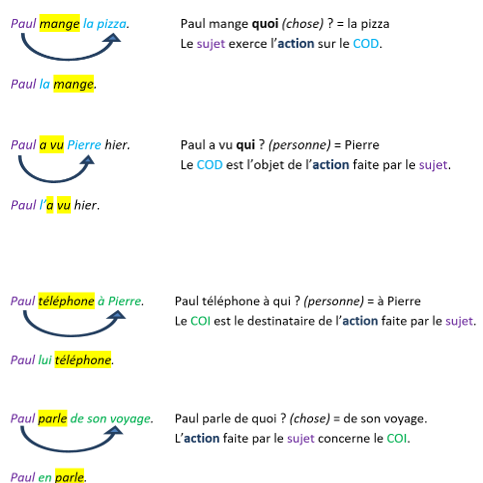
- The direct object complement COD answers the questions "qui?", "quoi?".
COD corresponds to the person, animal, or thing that is the subject of the action expressed by the verb.
COD noum is placed directly after the verb. It is constructed without a preposition.
subject + verb + COD noum
- The indirect object complement COI answers the questions "à qui?", "à quoi?", "de qui?", "de quoi?".
COI corresponds to the person, animal, or thing that is the subject of the action expressed by the verb.
The preposition à or de links the verb to the COI noum.
subject + verb + à/de + COI noum
French nouns are either masculine or feminine. When you learn a new word, you absolutely must memorize the gender by associating it with the correct definite or indefinite article. The gender of nouns is arbitrary. Fortunately, there are some rules I will share with you.
la / une pizza
le / un gâteau
- The gender of the noun influences the determiner and the adjective associated with it in the sentence.
- The gender of the noun also influences the choice of personal pronoun that replaces it in the next sentence or in the conversation.
French personal pronouns respect gender and number. Furthermore, they are placed before or after the verb. Choosing the right personal pronoun and placing it in the right place in the sentence is a real challenge!
Read these sentences, and notice the personal pronouns that are used to replace the COD and COI.
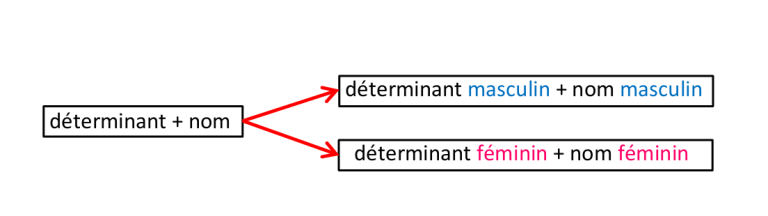
The determiner comes before the noun. It agrees in gender (masculine/feminine) and number (singular/plural) with the noun.
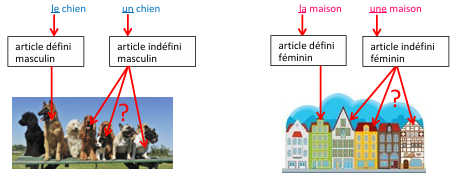
In French, there is always a determiner before the noun. There are many possibilities. You must ask yourself what you want to express in order to avoid making a mistake. For example, you need to understand the difference between definite and indefinite articles.
Direct object personal pronouns are all placed before the verb. But indirect object personal pronouns are either before or after the verb.
- As-tu lu ce livre ?
- Oui, je l'ai lu.
- Est-ce que tu manges souvent du fromage ?
- Oui, j'en mange souvent.
- Est-ce que tu as téléphoné à ton frère ?
- Oui, je lui ai téléphoné hier.
- Est-ce qu'il joue bien de la guitare ?
- Oui, il en joue très bien !
- Est-ce que tu te souviens de tes grands-parents ?
- Oui, je me souviens bien d'eux.
There is a wide variety of personal pronouns. Several criteria must be taken into account to avoid making mistakes. Do not worry! I will tell you more about this during your next French lessons.
Most French adjectives are after the noun except for some short and frequent adjectives:
un petit jardin, une longue histoire, un vieil homme,
une jeune fille, un bel oiseau, une bonne journée,
un grand appartement, une grosse part de gâteau,
une haute montagne, une mauvaise note,
un nouvel ami, un vilain garçon, un gentil garçon,
une fausse alerte, une jolie ville, une brève histoire,
un bon restaurant, le meilleur restaurant
Nous avons besoin de votre consentement pour charger les traductions
Nous utilisons un service tiers pour traduire le contenu du site web qui peut collecter des données sur votre activité. Veuillez consulter les détails dans la politique de confidentialité et accepter le service pour voir les traductions.